
Balancing a medical career with starting or raising a family can feel impossible, especially when the advice you keep hearing is to do it all and work twice as hard. But what if the problem isn't your time management, your ambition, or your ability to cope? Here's why the usual career advice fails women in medicine, how the hidden curriculum shapes your opportunities, and what a more strategic approach looks like in practice.
Why the usual career advice fails women in medicine
The most common advice we get as women physicians is some version of this. Be a superwoman. Work twice as hard. Prove you deserve flexibility, and eventually you'll be granted it.
When that doesn't work, the quieter suggestion arrives: put the career first and delay the family. It's why egg freezing has become such a popular workplace benefit.
On the surface, both sound practical. In reality, both assume you're operating in a fair system where effort is weighed the same no matter who's exerting it.
That assumption is the problem.
After 15 years of becoming a double board-certified trauma surgeon and raising six children, I nearly walked away from medicine in my first year as an attending. Not because I lacked discipline. Because the structure around me was never built to support a woman who wanted a demanding career and a family at the same time.
When I got pregnant during training, I was told, "It's never been done, and it will never be done." There was no maternity leave policy, because the last resident who tried had gone out on leave and never come back. After I became board certified, I lost job opportunities the moment I asked about schedule flexibility and mentioned I had six kids.
That isn't a personal failure. It's a system failure, and it produces exactly what you'd expect. Women get exhausted performing inside a structure that penalizes the choices they're being told to make. They burn out. They hold back from promotions. They stop speaking up. Some go part-time, and some leave clinical leadership entirely.
The shift that changes everything is this. Stop asking how you survive this system and start questioning the system itself.
Step one: Understand the system you're navigating
The first move in the Defiant Career Strategy is to stop assuming the playing field is level. It isn't, and everyone in the building knows it isn't.
Some people have stronger networks, better sponsors, more flexible roles, and fewer penalties when they prioritize their families. Others are expected to prove themselves over and over just to be considered for the same thing.
That unequal access matters, because traditional career advice was built for a world that doesn't exist. Work hard and good things will happen only holds if hard work is recognized fairly. If your hard work is invisible, discounted, or used against you, effort alone won't move your career.
And the system here isn't only the hospital. Your home, your community, your support structure, and the expectations of the society around you all shape what's actually possible. You're expected to compete at work as though you don't have a family and run a household as though you don't have a job. That double expectation creates chronic pressure, and no calendar app has ever solved it.
This is where most of us get stuck. We keep optimizing ourselves inside a structure that needed to be examined first.
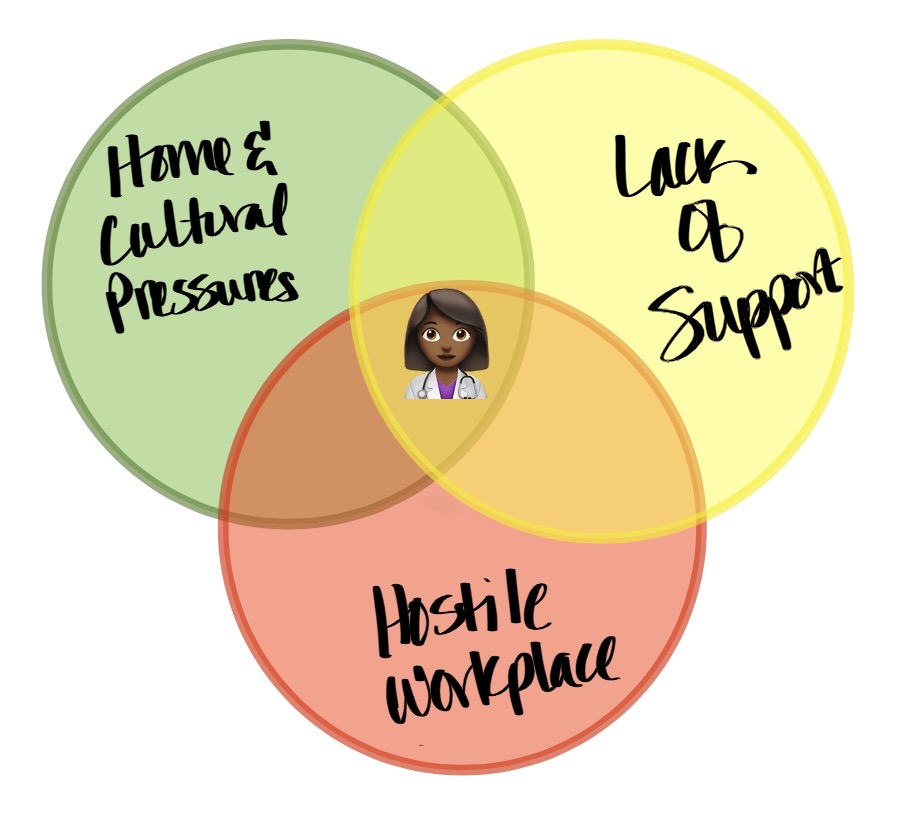 Systems affecting women physicians, including workplace, home, community, and society
Once you can see that the problem is structural rather than personal, you can stop treating the struggle as evidence that you're not capable enough.
Step two: Learn to read the hidden curriculum
When the rules are unfair, they're usually also unspoken. That's what makes the hidden curriculum so effective.
Medicine has formal policies and published training pathways. It also has a second set of expectations about who is serious, who is committed, and who is allowed to ask for flexibility. Nobody hands you that set. You're evaluated against it anyway.
The same action gets read differently depending on who takes it. Ask about schedule flexibility as a mother and you may be marked as less dedicated. A male colleague asking the identical question is negotiating. If you're a Black woman, or from any other minoritized group, those interpretations get more punitive again.
Here's some of what that second set governs:
- Who gets called aggressive and who gets called confident for the same behavior
- Who is assumed to be available after hours
- Who gets interrupted in meetings
- Who is expected to be grateful for basic flexibility
- Who is penalized for prioritizing caregiving
None of it is written down, and all of it shapes promotions, collaborations, leadership opportunities, and the way people speak to you.
This isn't about becoming cynical. It's about becoming clear-eyed. Once you can name the real rules, you stop spending energy trying to perform your way into a fairness that was never part of the culture.
Step three: Stop coping and start strategizing
Coping is not the same thing as strategizing. Coping gets you through the day. Strategy builds the career and the life you actually want.
Women in medicine get handed coping tools when what we need are structural ones. Meditate more. Organize better. Wake up earlier. Lean in harder. Those habits help at the margins, and they change nothing about a system that penalizes caregiving.
Strategizing means making decisions based on the environment you're actually in. In practice, that looks like:
Negotiating your schedule on purpose. Don't wait until burnout forces the conversation. Decide what your life needs to look like, then go in prepared to discuss it plainly.
Naming the silent rules out loud. If flexibility is being treated as a lack of commitment in your department, say so, at least to yourself, before you walk into the room. You can't negotiate around a rule you haven't identified.
Advocating from clarity instead of apology. When you understand the hidden curriculum, you can state what you need without over-explaining or bracing for a reaction.
Structuring work around your life rather than the reverse. The goal isn't to absorb every demand and hope balance shows up later. It's to build a career that fits your actual responsibilities and values.
I work half the month as a trauma surgeon. The other half I'm at basketball games and speech and debate competitions. That wasn't granted to me for good behavior, and it wasn't luck. It's what happened once I started treating career design as something I could shape instead of something I had to endure.
The same applies to advancement. If you want leadership, visibility, or better compensation, you need a plan that accounts for the environment you're operating in, not the one you were promised.

Dr. Qaali Hussein with family, in the operating room, and teaching
What this means for your career right now
If you feel stuck, it probably isn't that you're doing medicine wrong. It's that you're following advice built for a system that was never designed with your life in mind.
That's a hard thing to sit with. It's also freeing. Once you stop blaming yourself, you can start making different choices. You can look at your workplace, your support structure, and your goals honestly. And you can stop waiting for the culture to change before you take your next step.
The Defiant Career Strategy works in three steps:
- Understand the system you're actually navigating
- Learn to read the hidden curriculum
- Stop coping and start strategizing
That shift changes how you negotiate, where you set your limits, and how you define success.
If you're a woman in medicine trying to work out what comes next, stop measuring yourself against a model that was never built for you.
Start with clarity on what's actually holding you back. Take the Career Diagnostic. It takes about two minutes, it's free, and it's private.
Frequently asked questions
Why does the "do it all" advice fail women in medicine?
Because it assumes a fair system. In reality we're navigating bias, unequal expectations, and real penalties for family planning. Working harder inside those conditions isn't a solution, it's an incomplete one.
What is the hidden curriculum in medicine?
It's the set of unwritten rules that determine how people are judged, promoted, and supported. Those rules apply differently to women and to minoritized physicians than they do to their peers, which is why the same behavior produces different outcomes.
How do I start strategizing instead of coping?
Identify the systems affecting you first: workplace, home, and community. Then look for the unspoken rules shaping your options inside each one. From there you can make deliberate decisions about your schedule, your negotiations, and your path.
Can women in medicine really build successful careers and raise families?
Yes, though usually not by following traditional advice alone. It takes clearer boundaries, stronger advocacy, and a career strategy that accounts for the realities of caregiving and workplace culture.
