
Medical Culture Wasn't Designed for Women.
Your career strategy should be.
What if everything you've been taught about surviving medicine is the reason you're burning out? Work harder. Prove yourself. Don't make waves. That playbook was written by people who never had to navigate bias, caregiving, and invisible labor all at once — on top of caring for patients. There's a different one. Let me show you.
You thought you'd figured it out.
Everyone told you the same thing: the workplace is a level playing field. Work hard, keep your head down, prove yourself, and your work will speak for itself. Do that long enough and you'll have earned the recognition, the advancement, and enough leverage to build the flexibility you need.
So you did. You worked harder than anyone. You proved yourself over and over.
The problem? Year after year, the goalposts keep moving.
The recognition goes to someone else. The bias, the microaggressions, the quiet hostility show up anyway, daily, no matter how good your work is.
Maybe you know exactly what that looks like:
- Being interrupted, talked over, or ignored on rounds and in meetings
- Watching your idea get repeated by someone else and praised
- Being told to just build more resilience, when the culture is the problem
- Being seen as "difficult" for things your colleagues do freely
- Managing your tone and your likability on top of managing patients
- Holding your tongue out of fear of backlash or retaliation
- Being passed over for opportunities you'd more than earned
And when you name any of it, you get some version of: "That's just how it is. You can't change the system. There's nothing you can do."
If you'd known you'd spend this many years, and this much energy, building a career that still leaves you exhausted, overlooked, and questioning yourself, you'd have done something different a long time ago.
This is exactly where I was ten years ago. No matter how much career coaching I did or how many books I bought, I couldn't crack the code on surviving a hostile workplace, advancing anyway, and having anything left over for the rest of my life.
Maybe you feel the same way. Maybe you've tried:
- Working twice as hard to be undeniable
- Changing jobs, hoping the next place would be different
- Reporting to HR or leadership
- Pushing through and just enduring it
- Productivity systems and better time management
- Confidence work, affirmations, "fake it till you make it"
You've tried everything, and none of it worked. So at some point, you mostly stopped trying.
And here's what I need you to hear: that isn't a personal failure. It's a predictable result.
None of that advice worked because none of it was aimed at the real problem. It all assumed the system was fair and you were the thing that needed fixing: your confidence, your work ethic, your boundaries. But it isn't you. It never was you. It's a workplace that isn't built for you.

After trying so many "solutions," I almost walked away from a career I'd spent 15 years building.
Until one day, the surgery chairman interviewing me for a job threw my resume across the table and said "You've accomplished nothing over the past six years," simply because I asked about workplace flexibility. I had every other offer on the table rescinded the moment they found out I had five children. This was after years of being told that what I was aiming for, having children while becoming a surgeon, was "impossible." It took a mere six years for the "impossible" to become "nothing."
That's when I realized no amount of working hard and proving myself was ever going to be enough. I was navigating a system that couldn't see past my identity and my values, and no stack of accomplishments was going to overcome that.
So I stopped trying to be undeniable, and started being strategic.
If I wanted to reap the benefits of the career I'd spent 15 years building, I couldn't keep playing a game whose rules I'd never actually been taught. So I leaned on the complex problem-solving skills I'd built as a surgeon and approached my workplace the way I'd approach a hard case: as a system to be understood. I studied how workplaces actually function, and how we, as women and people of color, fit into them.
A real result
When Fatima came to me, she was a medical student on the verge of quitting medicine altogether. She was being bullied, and she'd decided she was done.
She didn't quit. Instead, she learned to advocate for herself, and she didn't just survive it. She changed the hospital's policy, went on to complete her residency, and is an attending physician today.
Fatima's story, a medical student who stayed, shared with permission.
The following year, I interviewed while eight months pregnant with baby #6. I spoke openly about my five children at home and my need for schedule flexibility. I told them I'd be wearing a hijab in the operating room. This time I had multiple offers, and I negotiated my schedule, my moving expenses, and a sign-on bonus. These weren't standard offers. They were terms I shaped.
And when I later walked into a hostile workplace where I was written up constantly and had my leadership questioned, I didn't crumble, I didn't leave, and I didn't put a bigger target on my back. I navigated it strategically, without ever compromising my patient care. I stayed 4.5 years and worked alongside some of the best trauma teams in the country.
Ten years later, I still practice full time. I have time for my children's ever-growing list of activities, including the speech and debate competitions they talk me into judging. And I get to pursue my passion for teaching and public speaking.
Here's what most people get wrong. They'll tell you the system can't change, that all you can do is adapt, endure, or leave. That's the story I was handed too.
But that isn't the case. When I got strategic, some of those workplaces actually changed. I negotiated a schedule they said wasn't possible. I set terms on my first day that shifted how I was treated. I walked into hostility and, instead of absorbing it, I moved in ways that changed the dynamic around me. The system isn't as fixed as it wants you to believe. It just requires you to understand how it works before you can move it.
That's the difference.
Most career advice works on you: your confidence, your mindset, your willingness to work harder. It assumes the system is fair and you're the variable that needs fixing. But you already know that isn't true. What no one teaches you is how the system actually operates, so you can stop only adapting to it and start making it adapt to you. That's the missing piece. That's the whole game.
- Imagine walking into any workplace and knowing how to read it, no matter what it throws at you.
- Imagine not being blindsided by hostility, but recognizing it early and being ready to handle it.
- Imagine never having to choose between advancing your career and having a life again.
As I started sharing this journey from the stage, women in medicine began asking me to help them do the same. So I turned everything I'd learned into a method: the Defiant Career Strategy. Since 2020, through Defiance Academy, I've used it to coach women physicians and trainees the culture was never built for.
The Strategy Room is the next step. It's where you learn and start implementing the Defiant Career Strategy early, beginning with Stage 1: Taking Up Space, so you don't have to wait years, or hit a breaking point, to start making medical culture work in your favor.
"I wish everybody, myself included, had heard this twenty years ago. It would've been a lot easier had we had this information early on."
The Strategy Room
A private program for early- and mid-career women in medicine who want to advance their careers and grow their families without burning out.
Perfect for the physician who's exhausted from fighting bias, afraid to speak up, and quietly wondering if she's cut out for this — when the truth is the culture was never built for her.
Inside The Strategy Room, you'll…
"The ROI for this program is literally career-saving. I went from questioning myself and watering down my own dreams because of the reality I was experiencing at the hospital. Now I'm fired up. It gave me the tools and the skills to navigate these spaces, and now I'm going back to work on my own terms."
What's Inside The Strategy Room
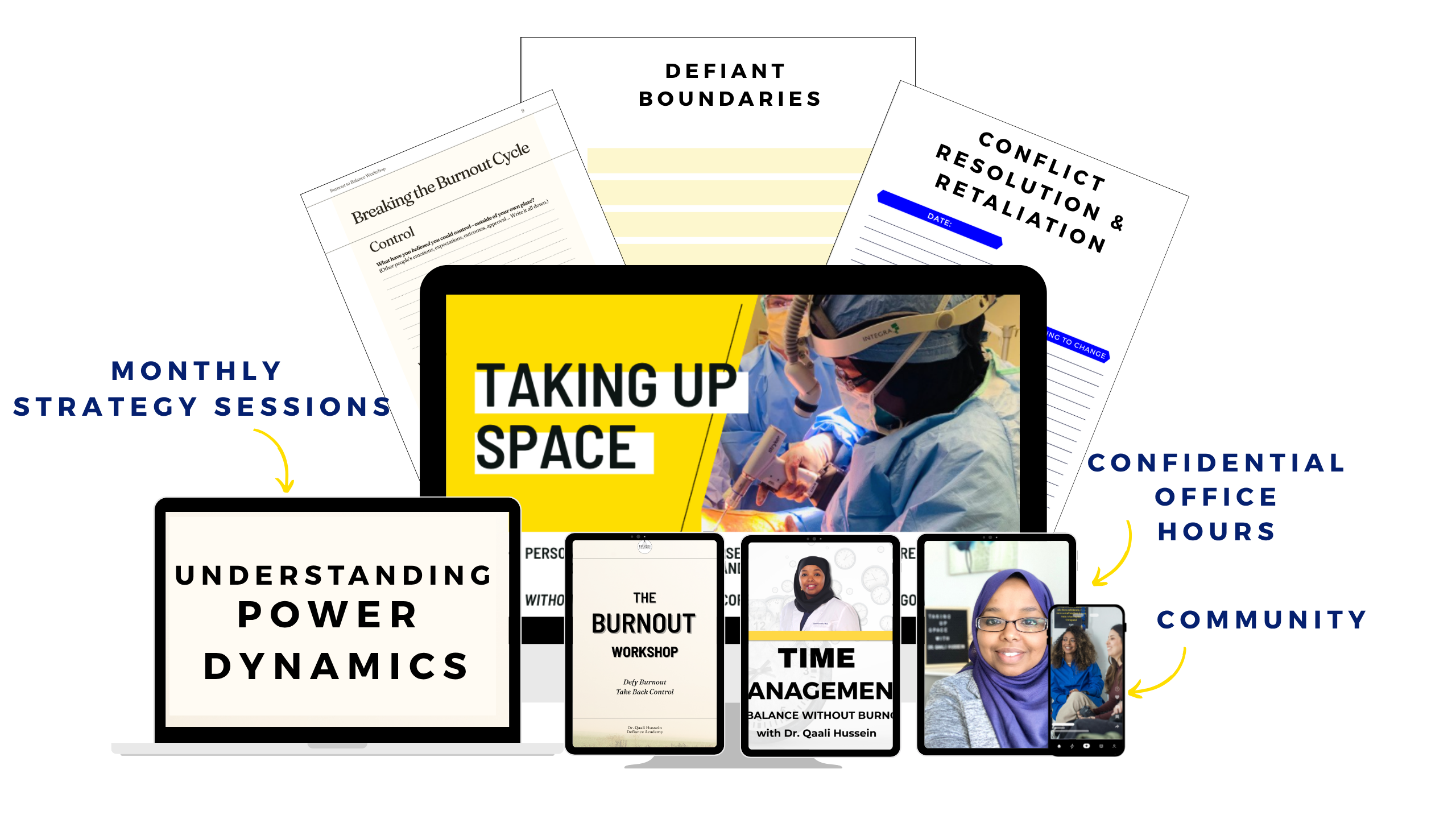
The Taking Up Space Program
The foundational program of the Defiant Career Strategy, delivered over four months. It shows you how medical culture actually works, where you fit inside it, why the advice you've been given backfires, and how to strategically maneuver through it.
You'll finish with a clear read on how your workplace really operates, and a personal strategy for moving through it instead of just coping.
Monthly Live Strategy Sessions
Live sessions where you apply the strategy in real time and troubleshoot the exact challenges you're facing on the ward, in the OR, or with leadership this month.
You'll walk away from each with a concrete next move for a real situation you're navigating.
Confidential Office Hours
Private, unrecorded sessions to strategize the sensitive, high-stakes situations you can't safely talk through anywhere else.
You'll have a plan for the situation you couldn't take to your program director, your chair, or your colleagues.
The Workshop Vault
Every workshop recorded and organized, so the full library of strategy is in your hands the moment something comes up.
You'll always have the right playbook on demand, on your schedule.
A Community of Women in Medicine
A private circle of physicians and trainees navigating the same terrain. Real support and accountability from women who don't need it explained.
No translating, no minimizing, no proving the problem is real before you get to solve it.
"I never thought I could delegate anything on my plate, let alone the three things I got off my plate in the first month. I've been able to really see why I almost gave up on my passion, and what I had to do to save my career and my health."

Ready to stop coping and start strategizing?
Book a strategy call and we'll look at where you're stuck, what the culture is really doing, and whether The Strategy Room is the right next step for you. No pressure, no pitch you didn't ask for.
Book a Strategy CallEvery month you wait, the culture keeps taking.
Another month of surviving instead of strategizing. Another round of second-guessing yourself and carrying weight no one sees. Another month of calling a system problem a personal failure. Medical culture is not going to fix itself while you wait.
And on the other side of a real strategy is the part that's hard to put into words: walking into work out of survival mode, knowing how the culture works and how to work it, with energy left for the people you love.
The only question is how much longer you do this the hard way.
Frequently Asked Questions
I'm already drowning. I don't have time for one more thing.
How is this different from the wellness, coaching, or DEI programs my institution offers?
Will this work if my program or hospital is genuinely hostile?
I already did coaching. Will this be any different?
What happens on the strategy call?
How much does it cost?
"My introduction to this work helped me see how I can make these systems work for me."

Ready to stop coping and start strategizing?
Book a Strategy CallHere's the truth…
Medical culture isn't going to redesign itself for you. No amount of leaning in, building your resilience, or waiting to be recognized is going to change how it actually works. The only thing that changes your position is learning to read it and moving strategically through it instead of just coping.
You can keep doing this the hard way: another year of second-guessing yourself, over-functioning, and carrying weight no one sees. Or you can step into The Strategy Room, finally understand how the culture really operates, and start making it work for you.
You've spent years navigating this terrain without a map. The Strategy Room is where you finally get one, built for women in medicine, by a surgeon who's walked it.
Let's get started.Dr. Qaali
Book a Strategy Call